Introduction
If you’re wondering why your website is not ranking on Google, you’re not alone.
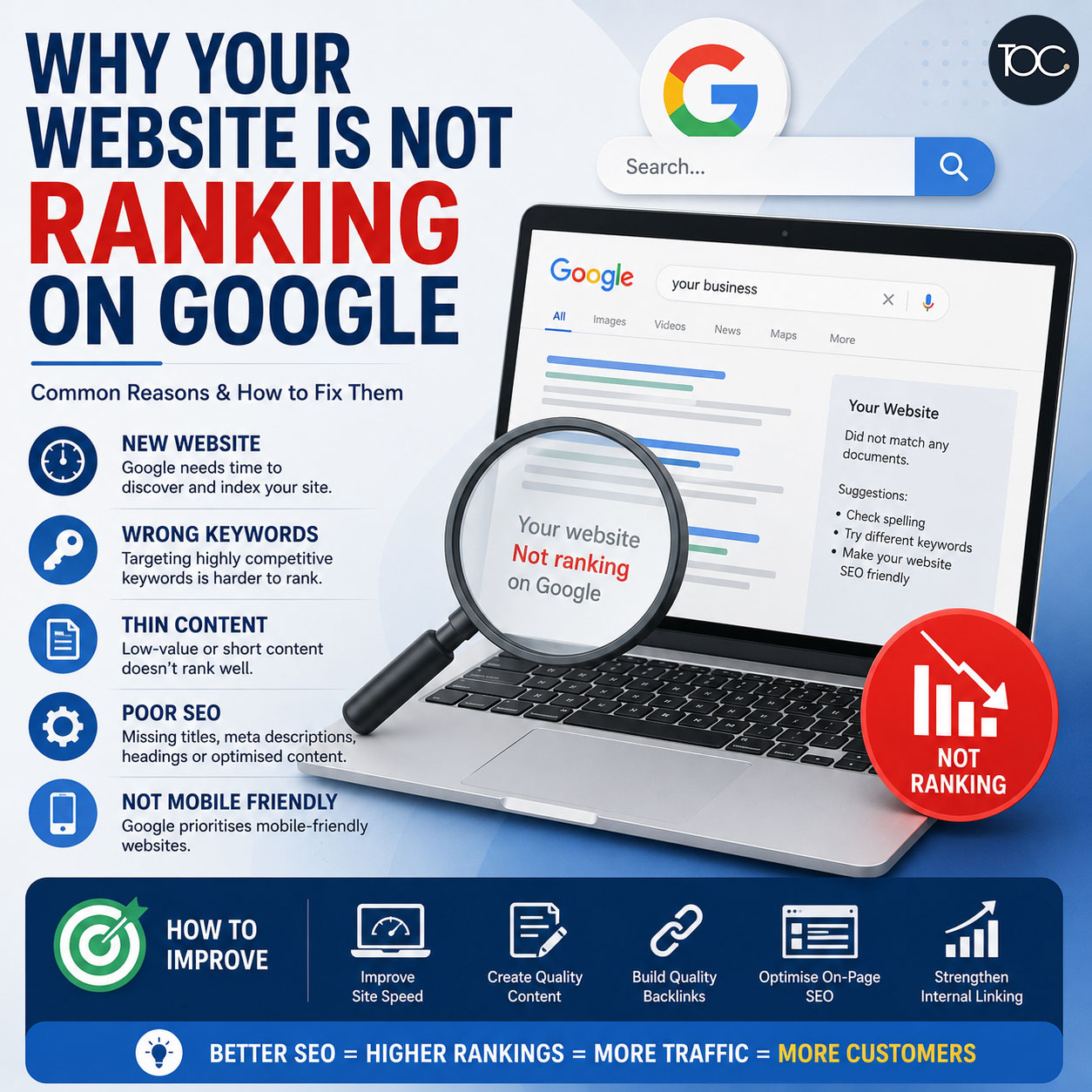
Many business owners invest in a professional website but become frustrated when they struggle to appear in search results. Having a website does not automatically guarantee visibility on Google. Search engine rankings depend on a combination of factors, including website structure, content quality, user experience, and SEO optimisation.
The good news is that most ranking issues can be identified and fixed.
In this guide, we’ll explore the most common reasons websites fail to rank on Google and what you can do to improve your visibility.
Table of Content
1. Your Website Is Too New
Google needs time to discover, crawl, and index new websites.
If your website was launched recently, it may take several weeks or even months before Google starts ranking your pages.
To help speed up the process:
- Submit your website to Google Search Console
- Create and submit an XML sitemap
- Publish quality content regularly
- Build internal links between pages
Patience is important, especially for new websites.
2. You Are Targeting the Wrong Keywords
Many websites try to rank for highly competitive keywords that are difficult to achieve.
For example:
- “web design”
- “website design”
- “SEO”
These keywords are extremely competitive.
Instead, focus on more specific search terms such as:
- web design singapore
- wordpress website singapore
- website maintenance singapore
Targeting relevant keywords improves your chances of ranking.
3. Your Website Content Is Too Thin
Google prefers websites that provide useful and valuable information.
If your pages contain only a few paragraphs of content, Google may not see them as authoritative.
Good content should:
- Answer user questions
- Provide useful insights
- Be well-structured
- Include relevant keywords naturally
Publishing helpful blog articles is one of the best ways to improve SEO.
4. Poor On-Page SEO
On-page SEO helps search engines understand your content.
Common issues include:
- Missing title tags
- Missing meta descriptions
- No H1 headings
- Poor keyword usage
- Duplicate content
Every page should be properly optimised for its target keyword.
5. Your Website Is Slow
Website speed is an important ranking factor.
Slow websites can negatively impact:
- User experience
- Conversion rates
- Search rankings
Common causes include:
- Large image files
- Poor hosting
- Excessive plugins
- Unoptimised code
Improving website speed can benefit both SEO and user engagement.
6. Your Website Is Not Mobile-Friendly
Most searches today happen on mobile devices.
Google uses mobile-first indexing, meaning it primarily evaluates the mobile version of your website.
If your website is difficult to use on smartphones or tablets, rankings may suffer.
A responsive design is essential for modern SEO.
👉 Related Reading: Responsive Web Design Explained: Why It Matters for Singapore Businesses
7. Google Cannot Properly Crawl Your Website
Sometimes websites unintentionally block search engines.
Common issues include:
- Noindex tags
- Blocked robots.txt settings
- Broken links
- Technical errors
Using Google Search Console can help identify these problems.
8. You Have Very Few Backlinks
Backlinks remain one of Google’s most important ranking signals.
A backlink is a link from another website to yours.
High-quality backlinks help Google view your website as trustworthy and authoritative.
Ways to earn backlinks include:
- Publishing useful content
- Guest posting
- Industry partnerships
- Business directories
- Portfolio and project showcases
9. Your Website Lacks Internal Linking
Internal links help search engines understand your website structure.
They also help distribute authority between pages.
For example, this article can link to:
- Is WordPress Good for SEO?
- Website Design Mistakes Singapore Businesses Should Avoid
- How to Improve Website Conversion Rates for Singapore Businesses
A strong internal linking strategy improves SEO performance.
10. Your Competitors Have Stronger SEO
Sometimes your website is doing everything correctly, but competitors have:
- More content
- Better backlinks
- Higher authority
- Longer online history
SEO is a long-term strategy.
Consistently improving your website and publishing quality content can help you close the gap over time.
11. How to Improve Your Google Rankings
If your website is not ranking well, focus on:
Create Quality Content
Publish useful articles that answer customer questions.
Optimise On-Page SEO
Ensure every page has:
- SEO title
- Meta description
- Proper headings
- Target keywords
Improve Website Speed
Optimise images and use quality hosting.
Build Backlinks
Earn links from reputable websites.
Strengthen Internal Linking
Connect related pages and blog posts.
Update Content Regularly
Fresh content signals that your website remains active and relevant.
12. Final Thoughts
Understanding why your website is not ranking on Google is the first step toward improving your SEO performance.
In most cases, ranking problems are caused by a combination of:
- Weak content
- Poor SEO optimisation
- Technical issues
- Lack of backlinks
By addressing these areas and consistently improving your website, you can increase your visibility, attract more visitors, and generate more enquiries.
SEO takes time, but the long-term benefits are worth the investment.
13. Frequently Asked Questions
13. Frequently Asked Questions
14. Ready to Improve Your Website’s Google Rankings?
If your website is struggling to appear on Google, the issue may be your SEO strategy, website structure, or overall optimisation.
We build SEO-friendly WordPress websites designed to improve search visibility, user experience, and lead generation.
Contact us today for a free, no-obligation consultation and discover how we can help your website rank higher on Google.