Introduction
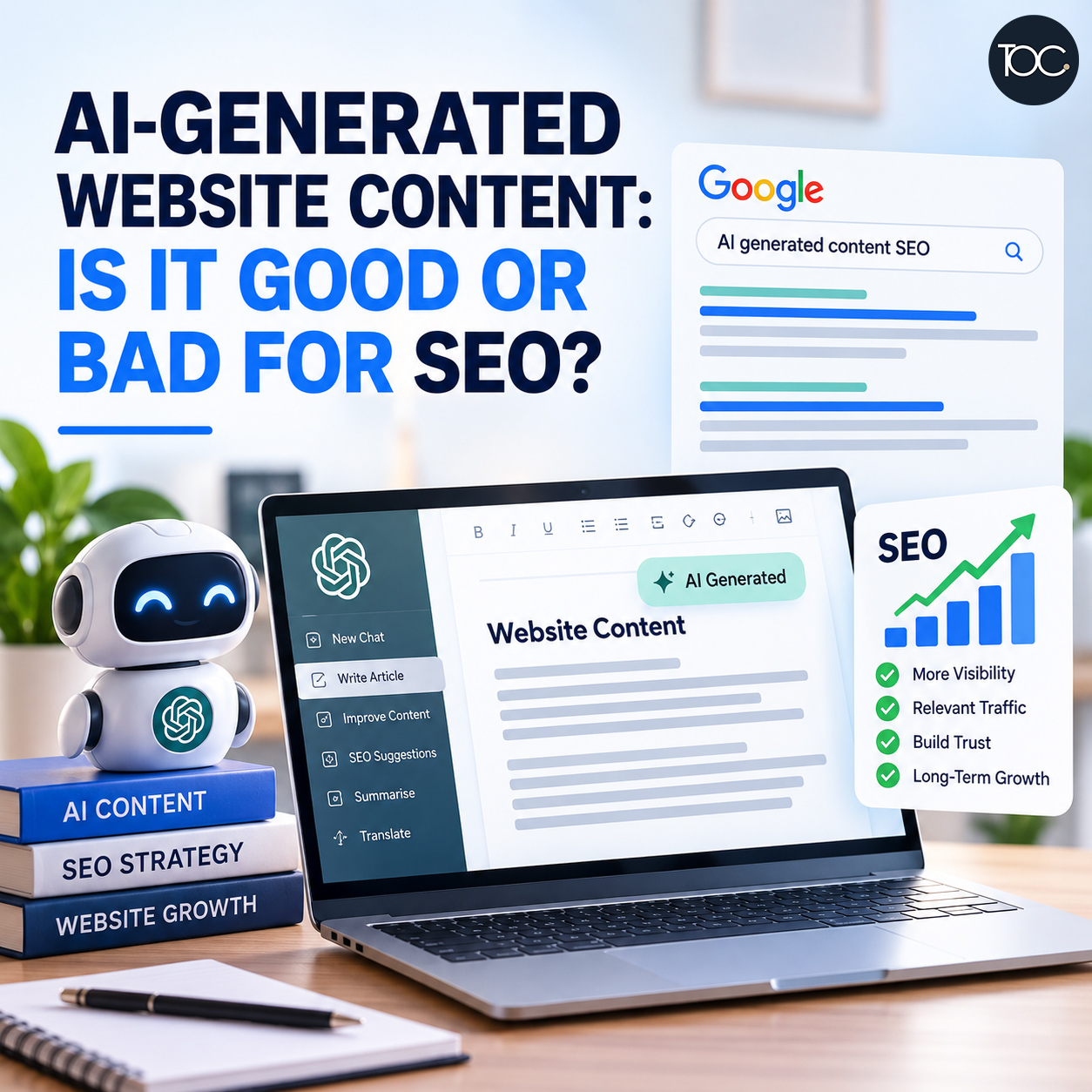
AI-generated content SEO has become an important topic as more businesses use artificial intelligence tools such as ChatGPT to create website content, blog articles, product descriptions and marketing materials.
In the past, creating quality website content required considerable time and effort. Today, AI can generate an entire article within seconds, making content creation faster and more accessible for small businesses in Singapore.
But this raises an important question:
Is AI-generated website content actually good or bad for SEO?
Some business owners worry that Google may penalise websites for using AI-written content. Others believe publishing large numbers of AI-generated articles will automatically improve their Google rankings.
The reality is that Google doesn’t automatically penalise content simply because it was created using AI. What matters is whether the content is helpful, accurate, relevant and created primarily for people rather than to manipulate search rankings.
AI can be a valuable tool for content creation, but relying entirely on it without proper review can lead to generic, repetitive or inaccurate information.
In this article, we’ll explain how AI-generated content affects SEO, what Google says about AI-written articles, and how businesses can use AI effectively without compromising content quality.
Table of Content
1. What Is AI-Generated Website Content?
AI-generated website content refers to text and other materials created with the assistance of artificial intelligence.
Tools such as ChatGPT can help businesses generate:
- Homepage and service page content
- Blog articles
- Product descriptions
- Frequently Asked Questions
- SEO titles and meta descriptions
- Landing page content
- Marketing copy
For example, a business owner can ask AI to write an article about WordPress website maintenance and receive a complete draft within seconds.
However, producing content quickly doesn’t automatically mean the information is accurate, original or useful.
The final quality depends on how the content is reviewed and improved before publishing.
2. Does Google Allow AI-Generated Content?
Yes. Google doesn’t prohibit website content simply because artificial intelligence was used to create it.
Google’s guidance focuses on producing helpful, reliable and people-first content, regardless of whether it was created by a human or with AI assistance.
However, Google also warns against using AI or other automation to generate large quantities of low-value content primarily to manipulate search rankings.
For example, publishing hundreds of nearly identical articles targeting slightly different keywords without providing meaningful value may violate Google’s spam policies.
The important distinction is:
Using AI to create helpful content is acceptable. Using AI to manipulate search rankings can create SEO problems.
You can read more in Google’s official guidance on generative AI content.
3. Can AI-Generated Content Rank on Google?
Yes. AI-generated content can rank on Google if it satisfies search intent and provides useful information.
However, using AI doesn’t provide any special ranking advantage.
Google evaluates many signals when determining search results, including:
- Content relevance and quality
- Search intent
- Website authority
- Original and helpful information
- Technical SEO
- Internal linking
- Backlinks
- User experience
An AI-assisted article that thoroughly answers a genuine customer question may perform well.
On the other hand, an article that repeats generic information already available across hundreds of websites may struggle to stand out.
AI makes content creation faster, but it doesn’t guarantee better Google rankings.
4. What Are the Benefits of Using AI for Website Content?
AI can offer several advantages when used correctly.
Faster Content Creation
AI can help produce initial drafts much faster than writing everything from scratch.
Better Content Structure
It can organise information into headings, sections and FAQs, making articles easier to read.
Content Ideas
AI can suggest blog topics based on your services and common customer questions.
Grammar and Readability
It can improve sentence structure, correct grammar and simplify technical explanations.
SEO Assistance
AI can suggest focus keywords, SEO titles, meta descriptions and related topics. However, keyword suggestions should still be validated using reliable SEO research tools.
For small businesses without a dedicated content team, these capabilities can make website content creation more manageable.
5. What Are the Risks of AI-Generated Content for SEO?
Although AI offers many benefits, publishing content without proper review can create problems.
Inaccurate Information
AI can generate convincing explanations that contain factual errors or outdated information.
Generic Content
AI-written articles may repeat information already widely available online without offering anything new.
Repetitive Writing
Some AI-generated articles repeat the same points across multiple sections, making them unnecessarily long.
Lack of Real Experience
AI doesn’t automatically know your company’s projects, customer experiences or business processes.
Incorrect Business Claims
AI may incorrectly describe services, pricing, achievements or capabilities that your company doesn’t actually offer.
These issues can affect website credibility and content quality.
6. Why Human Experience Matters for SEO
One of the biggest weaknesses of generic AI-generated content is the lack of genuine business experience.
For example, AI might write:
“Website maintenance helps keep your WordPress website secure and updated.”
While this statement is correct, it doesn’t provide much practical insight.
An experienced WordPress developer may explain:
“Many business owners assume website maintenance only involves updating text and images. When they don’t need content changes, they believe maintenance is unnecessary. However, WordPress core, plugins, themes and security still require technical maintenance even when the visible content remains unchanged.”
This explanation addresses a real customer misunderstanding.
It provides useful information based on actual business experience rather than a generic definition.
Google’s content quality guidance also discusses E-E-A-T: Experience, Expertise, Authoritativeness and Trustworthiness.
Although E-E-A-T isn’t a single ranking score, demonstrating genuine knowledge and providing trustworthy information can make your content more valuable to readers.
7. Can Google Detect or Penalise AI-Generated Content?
Google uses automated systems to evaluate content quality and detect spam.
However, businesses shouldn’t assume that Google automatically penalises an article simply because AI helped write it.
Google’s published guidance focuses on the quality and purpose of the content.
Problems may arise when businesses use AI to mass-produce low-value pages primarily to manipulate search results.
Instead of asking:
“Can Google detect that this article was written by AI?”
A more useful question is:
“Does this article genuinely help someone looking for this information?”
That should be the main consideration before publishing any website content.
8. Should Businesses Use AI for Service Pages and Blog Articles?
Yes, but the content should always reflect the actual business.
For service pages, AI can help explain:
- What the service includes
- Who the service is suitable for
- Common customer problems
- Benefits of the service
- Frequently Asked Questions
However, businesses must verify that the descriptions accurately represent what they provide.
For blog articles, AI can help turn real customer questions into educational content.
For example, a WordPress development company might create articles about:
- Website maintenance
- WordPress security
- Website hosting
- SEO
- eCommerce development
- Website performance
The key is to combine AI assistance with genuine professional knowledge and practical examples.
9. Best Practices for Using AI to Create SEO-Friendly Content
A structured approach can help businesses use AI effectively.
Step 1: Choose a Relevant Topic
Focus on questions your potential customers genuinely ask.
Step 2: Provide AI With Clear Instructions
Explain your target audience, services, writing style and article objectives.
Step 3: Generate an Initial Draft
Use AI to organise the information into a clear structure.
Step 4: Add Your Own Experience
Include genuine customer questions, practical examples and professional insights.
Step 5: Verify the Information
Check important facts, statistics, technical details and business claims.
Step 6: Optimise for SEO
Review the SEO title, meta description, headings, focus keyword, internal links and search intent.
Step 7: Review Before Publishing
Remove repetitive paragraphs, improve readability and ensure the content is useful to visitors.
Step 8: Monitor and Improve
Use Google Search Console and website analytics to understand performance and identify opportunities for improvement.
The best approach is to use AI as a writing assistant rather than relying on it to replace human judgement.
10. Common AI Content Mistakes Businesses Should Avoid
Some common mistakes include:
- Publishing AI content without reviewing it
- Generating articles purely to target keywords
- Repeating the same information across multiple pages
- Using incorrect or unverified statistics
- Inventing customer testimonials or achievements
- Copying competitors’ content
- Overusing focus keywords
- Ignoring search intent
- Publishing topics unrelated to the business
- Forgetting relevant internal links
Avoiding these mistakes can help businesses create more useful content and maintain their credibility.
Remember that a high Rank Math SEO score doesn’t automatically guarantee better Google rankings.
SEO tools are useful for checking basic optimisation, but content quality and relevance remain important.
11. AI-Generated Content SEO: Is It Good or Bad for Google?
The answer depends on how AI is used.
AI-generated content can be beneficial when it helps businesses produce accurate, relevant and helpful information.
However, it can be harmful to SEO efforts when used to publish large quantities of generic, misleading or low-value content.
The important distinction isn’t simply:
AI-Generated Content vs Human-Written Content
It is:
Helpful Content vs Low-Value Content
AI is a tool. The quality of the final article still depends on the knowledge, judgement and effort behind it.
12. Final Thoughts
So, is AI-generated website content good or bad for SEO?
AI-generated content isn’t automatically good or bad. What matters is how it is created, reviewed and used.
For small businesses in Singapore, AI can make website content creation faster and more efficient.
However, businesses shouldn’t confuse faster content production with better content quality.
A good SEO article should:
- Answer genuine customer questions
- Provide accurate information
- Demonstrate relevant knowledge
- Include practical insights
- Be easy to understand
- Support the website’s overall purpose
The best approach is:
AI Assistance + Human Experience + Fact-Checking + SEO Best Practices = Better Website Content
Use AI to support your content creation process, but don’t allow it to replace your business knowledge.
Ultimately, your website should provide information that potential customers can trust—not simply content created to fill pages or target keywords.
13. Frequently Asked Questions
13. Frequently Asked Questions
14. Need Help Building an SEO-Friendly WordPress Website?
AI can help businesses create website content more efficiently, but good content is only one part of a successful website.
Your website also needs to be properly designed, structured, optimised and maintained.
At THEOLDCOMPANY, we specialise in WordPress website design and development for businesses in Singapore.
Our services include:
- WordPress website design and development
- SEO-friendly website structure
- On-page SEO fundamentals
- Mobile responsive design
- Website performance optimisation
- Content organisation and internal linking
- WordPress maintenance
- Web hosting
Whether you’re building a new website or improving an existing one, we can help create a strong technical foundation that supports your business and long-term online visibility.
AI can assist with content creation, but a well-planned website remains essential for turning visitors into potential customers.
📩 Contact us today for a free, no-obligation consultation to discuss your WordPress website requirements.